
Found a swarm? Give us a call and we'll come collect them free of charge.* Swarms are clusters of honeybees looking for a new home — they're rarely dangerous and should be left alone or collected by a beekeeper. Don't spray or disturb them.
Free swarm collection across the Harrisburg metro — Hummelstown, Hershey, Harrisburg, Mechanicsburg, Palmyra, Lancaster, and surrounding Central PA boroughs. Full service area ↓
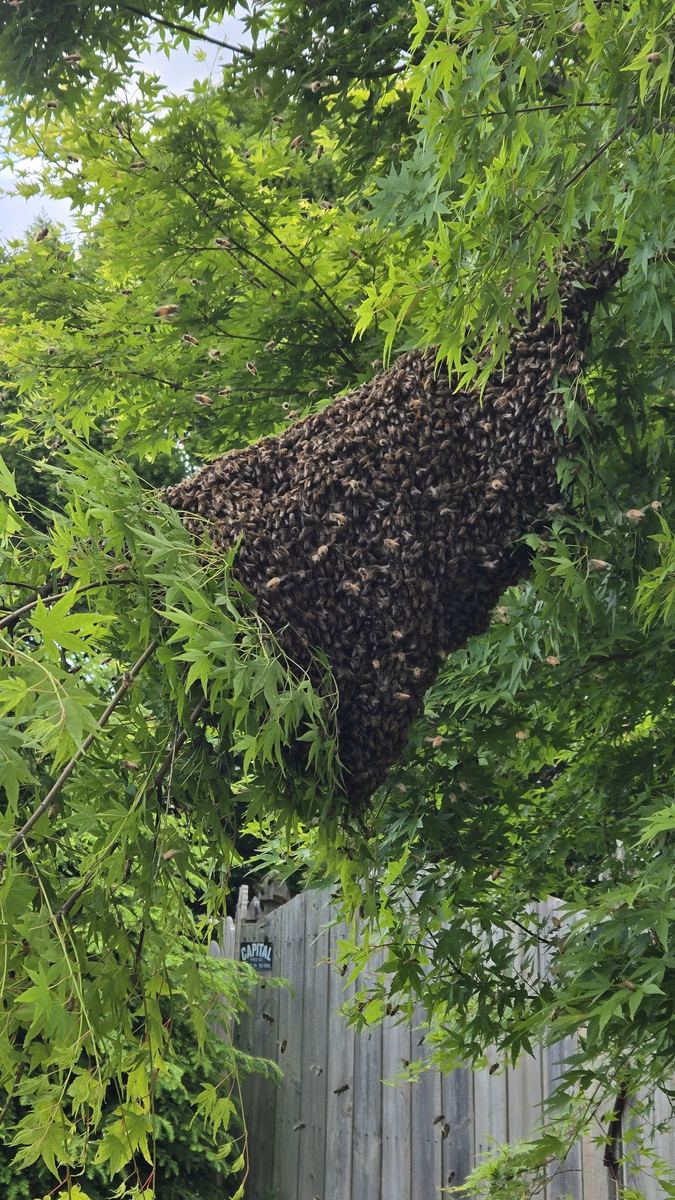
What a Swarm Looks Like
A honeybee swarm is a tight, mostly round cluster of thousands of bees — usually about the size of a football or basketball — that has temporarily landed on a branch, fence, mailbox, or wall. The bees are looking for a permanent home and have stopped to rest while scout bees search for a suitable cavity.
Swarms are typically the most docile state honeybees ever enter. They've gorged themselves on honey before leaving the old hive, they have no babies or food stores to defend, and they're focused on finding a new home. Keep pets and kids back about 20–30 feet and the cluster will leave you alone.
Not sure what you've got? Send us a photo!
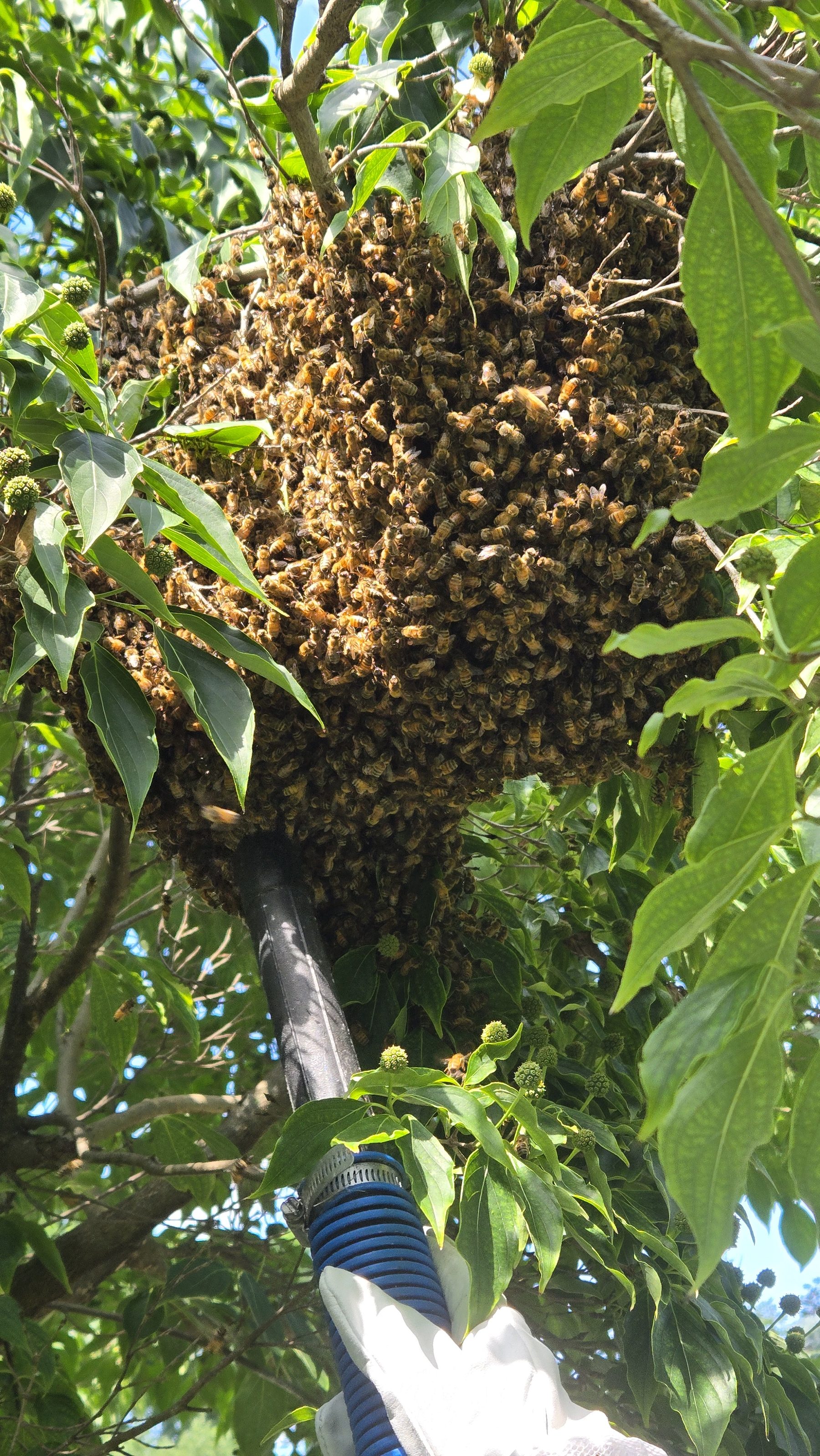
What to Do While You Wait
- Call or text us with a photo and the location. A photo helps us identify the species and bring the right gear.
- Keep pets and kids back 20–30 feet. Swarms are calm but bees still defend themselves if pressed against.
- Don't spray it. Not water, not soap, not insecticide. Spraying agitates the bees, often hurts the queen, and can turn a peaceful cluster into a defensive one.
- Don't try to capture it yourself unless you're a beekeeper. Without the right equipment you'll likely lose the queen and the colony will scatter.
- Note any movement. If the swarm starts to break up while you watch, let us know — they may be heading to a chosen cavity.
Why Have a Swarm Collected
A swarm in your yard is a colony actively house-hunting. If you leave it alone, one of two things happens, and neither is great.
It moves into a structure. Within hours, scout bees can find a cavity and the whole colony will move in — often into a wall, soffit, chimney, or shed. Once they're inside, you're looking at a paid honeybee removal instead of a free swarm collection.
Or it tries to survive on its own and usually doesn't. Cornell research on feral honey bee colonies near Ithaca, NY found that only about 23% of new founder-year colonies survive their first winter1. Without a beekeeper monitoring for varroa mites, disease, and winter food stores, an unmanaged swarm in Central PA usually doesn't make it through. The same colony in our apiary, with proper care, has a much better shot.
1 Seeley T.D. et al., “Life-history traits of wild honey bee colonies living in forests around Ithaca, NY, USA,” Apidologie (2017).
Where We Collect Swarms
We collect swarms across the Harrisburg metro and Central Pennsylvania — Hummelstown, Hershey, Harrisburg, Mechanicsburg, Palmyra, Middletown, Elizabethtown, Linglestown, Colonial Park, Camp Hill, and Lancaster, plus the West Shore boroughs (Lemoyne, Wormleysburg, New Cumberland) and out to Steelton, Lebanon, and Grantville.
Outside the area? We can't make a long drive, but the swarm can still be saved — the Pennsylvania State Beekeepers Association keeps a statewide swarm list that can connect you with a beekeeper near you, usually free.
*All swarm collections are free. If a swarm is out of safe reach — high in a tree, requiring a lift, or already inside a wall — we may not be able to collect it, but we don't charge either way.