Bees in My Wall — What to Do (and What Not to Do)
May 4, 2026
If you’re reading this with bees flying in and out of your wall, take a breath. They’ve probably been there longer than you realize. A few hours one way or the other won’t change anything — but the next move you make will determine how clean the resolution is and how much it costs.
This is a working beekeeper’s walkthrough of what’s actually going on, what to do right now, what not to do, and exactly how the removal works once you call us. We’re Been’s Bees, a 10-year owner-operated beekeeping business in Hummelstown, PA. We do live honeybee removal across Central PA — actual extraction, never extermination. The colonies we collect go home with us to our apiaries.
Is it actually honeybees?
Three insects routinely get mistaken for honeybees, and the response is different for each:
- Honeybees — fuzzy, golden-brown with darker bands, about half an inch long. Pretty calm flyers. Build wax comb. This is the one we handle.
- Yellow-jackets and hornets — slick, smooth, brighter yellow stripes, more aggressive flight pattern. Build paper nests, not wax. Call a licensed exterminator. We don’t do these.
- Carpenter bees — large solitary bees that bore perfect-circle holes in wood eaves and trim. They don’t form colonies. Different problem entirely; carpenter-bee specialists or pest companies handle these.
If you can safely take a photo, text it to us at (717) 583-8332. We can usually identify the species in a few seconds and tell you whether it’s our job or whether you need someone else.
What to do right now
- Watch them for five minutes from a safe distance. Are they flying in and out of one specific spot? That’s a colony. Where exactly is the entry — siding gap, soffit vent, weep hole, knot in trim? Note it.
- Take a photo of the entry point, the surrounding area, and the bees themselves if you can do it safely.
- Don’t disturb the entry. No spraying, no plugging, no covering with tape. We’ll get to why in a second.
- Call or text us at (717) 583-8332. Send the photo. We’ll schedule a free on-site estimate, usually within a few days, and we’ll prioritize urgent situations like bees actively coming through interior walls.
- In the meantime, keep pets and small kids away from the entry zone. Honeybees in normal foraging mode aren’t aggressive, but a sealed-up entry full of agitated bees can be.
What NOT to do
The single most expensive mistake homeowners make is trying to handle it themselves before calling. The three worst options:
Don’t spray. Bug spray, hornet spray, ammonia, vinegar, dish soap — none of it works on a wall colony, and several make things much worse. A poisoned colony left in a wall causes:
- Tens of thousands of dead bees rotting in the cavity
- Abandoned honeycomb that attracts ants, wax moths, and rodents within weeks
- Untreated honey that ferments and can leak through drywall for months
- An empty cavity that becomes a beacon for the next swarm to move in next spring
A professional live removal is cheaper than fixing the damage caused by a spray gone wrong.
Don’t plug or seal the entry. A blocked entry traps the colony inside the wall. They will find another way out — often through interior drywall, vents, or electrical outlets. We’ve seen homeowners wake up to bees inside the bedroom because the entry hole got caulked the night before.
Don’t light a fire to flush bees from a chimney. This kills the colony, melts the wax comb into the flue, and creates a mess that requires a chimney sweep AND a beekeeper to clean up. Just call us.
Don’t try a DIY extraction. A wall colony usually contains 20,000–40,000 bees plus 10–40 pounds of honey-loaded comb. Without bee gear, the right vacuum, and structural experience, the most likely outcomes are: bad stings, damaged wall, dead colony, or all three. If you’re a hobbyist beekeeper with the gear and you want to try, call us first — we’re happy to talk through what you’re walking into.
How a real live removal actually works
Here’s our process, start to finish. We’ve done this hundreds of times across Central PA.
Step 1 — Locate the colony precisely
We arrive with a thermal camera. Honeybees keep the brood nest at 95°F year-round, which makes the colony glow on thermal — we can see exactly where it is and how big it is, even through drywall, plaster, or siding. If thermal isn’t conclusive (rare, but happens behind dense materials), we drill a small pilot hole and use a borescope to look inside the cavity.
Knowing exactly where the colony is and how big it is determines everything else: where we cut, what equipment we need, how long it takes, what we charge.
Step 2 — Decide on interior or exterior approach
Whichever side requires less destruction wins. A few rules of thumb:
- Crown molding / trim soffits — usually exterior. We remove a piece of siding or soffit and cut into the cavity from the back.
- Interior wall behind drywall — usually interior. We cut a clean rectangle out of the drywall, work through the studs, and patch back temporarily.
- Cinder block — depends on access; often exterior is cleaner.
- Attics — interior, working from inside the attic with full bee gear.
- Chimneys — exterior, often with a bucket lift, depending on the chimney height.
We use plastic sheeting and drop cloths to protect floors, carpets, and adjacent walls. There may be some residual dust during cutting; honey, if any drips, cleans off most surfaces with warm water.
Step 3 — Open the cavity carefully
Tools depend on the material — sawzalls and drywall spiral cutters for interior wall work, regular saws for siding, masonry tools for cinder block. We work slowly enough to avoid hitting pipes, wires, or comb we can’t see yet. Our liability insurance covers accidental damage to utilities like cut wires or pipes (it happens occasionally even with thermal scanning); it does not cover structural repairs (more on that below).
Step 4 — Vacuum the bees out alive
We use a purpose-built bee vacuum — either an Everything Bee Vac or a Colorado Bee Vac, depending on the job. These are professional bee removal tools designed to capture bees alive at low suction. Standard shop vacuums kill the colony instantly; that’s why pest companies who use shop vacs are doing extermination, not removal, no matter what they call it.
We work systematically through the comb, vacuuming bees off frame by frame. The queen often goes through the vacuum without us seeing her — that’s fine; she gets sorted out in the transport hive. If we spot her, we can capture and cage her separately to make the rest of the colony easier to manage.
Step 5 — Save the comb
Comb falls into three categories:
- Brood comb (eggs and developing bees) gets cut to fit a standard frame and rubber-banded into place. The bees rebuild attachment within a day or two of being placed in their new hive. Saving brood comb is the difference between a thriving colony in two weeks and a struggling colony in eight.
- Honey comb — if the homeowner provides a Tupperware or food-grade container, we’ll save the cleanest honey for them. It’s raw and hyper-local; nothing else compares to honey made literally inside your own walls. If you don’t want it, we’ll bring it to the apiary for the bees to clean up.
- Damaged or unusable comb — comes home with us and gets recycled into beeswax for our own use (candles, foundation, etc.). Nothing wasted.
Step 6 — Seal the cavity
After the bees are out, we seal the entry point with a long-term solution — usually screen and sealant for soffits, expanding foam plus screen for irregular openings, or whatever the specific material requires. The interior cut gets covered with heavy plastic sheeting and tape so your home is weatherproof until your repair crew gets to it.
Important: we don’t do repairs. We’re licensed and insured beekeepers, not contractors. We don’t have a contractor’s license, and our insurance covers extraction work — not drywall, siding, or roofing repair. Most homeowners hire a handyman after the removal; the typical patch-and-paint runs a few hundred dollars depending on what was opened up.
Step 7 — Transport home
The bees ride back with us in the bee vacuum, which doubles as a temporary transport hive. The salvaged brood comb travels separately to keep it from getting jostled. Once we get to one of our apiaries in Central PA, we transfer everyone into a fresh hive, install the brood comb in frames, and let them re-orient. Within 24 hours they’re flying out to forage on the same flowers, just from a different home.
The honey you see at our self-serve stand on Douglas Road in Hummelstown is partly made by these rescued colonies. Bees from a wall in Harrisburg, a soffit in Hershey, a chimney in Mechanicsburg — they all eventually go into the same jars.
Case study: a hidden bedroom colony in Central PA
To make all of that concrete, here’s an actual job we did. The homeowner heard buzzing in their bedroom wall but couldn’t see anything from outside or inside.
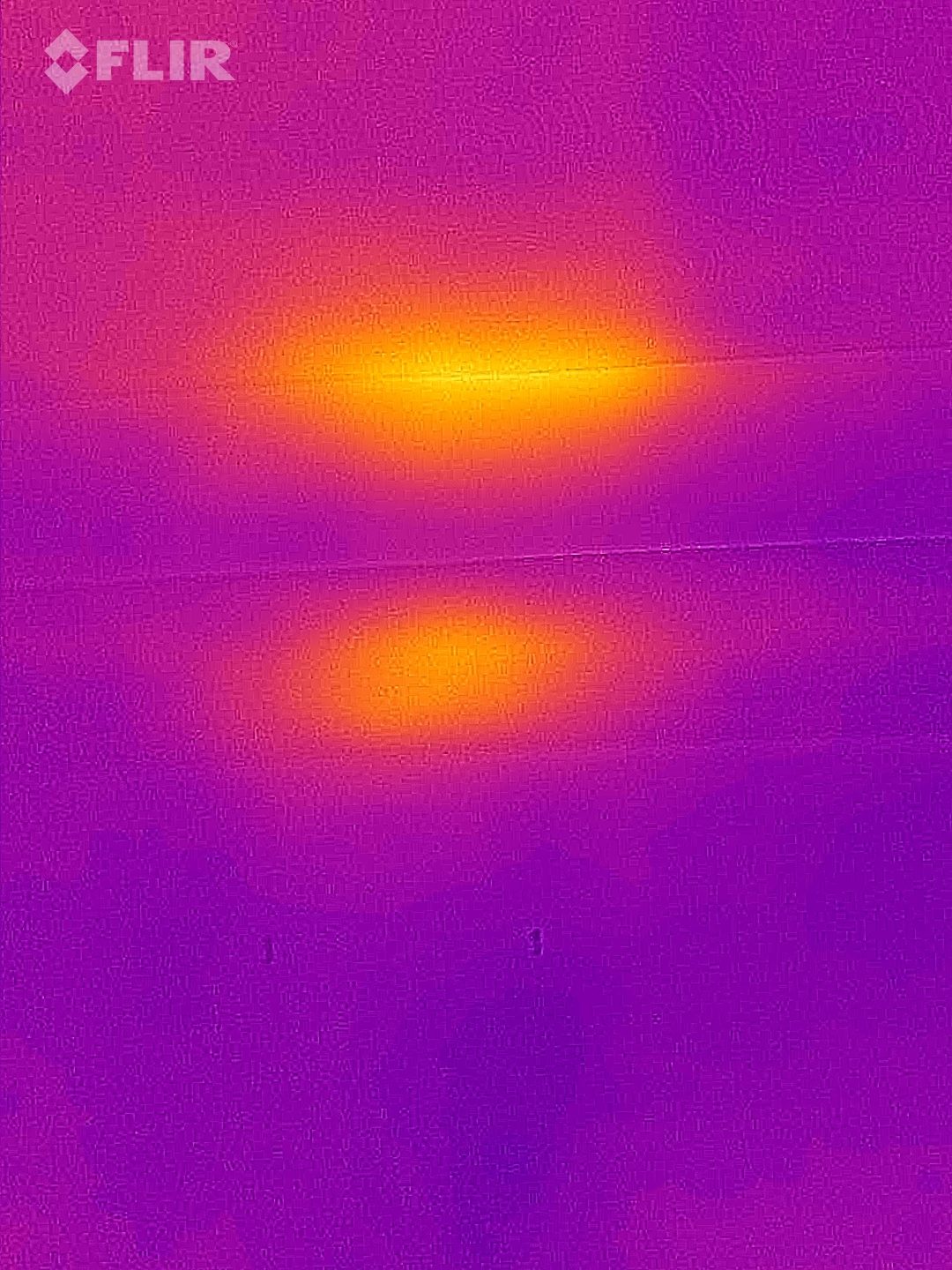
Step 1 — Thermal scan. The two bright orange heat signatures are the colony’s brood nest, kept at a steady 95°F by the bees, glowing through the drywall. Nothing visible to the eye yet.
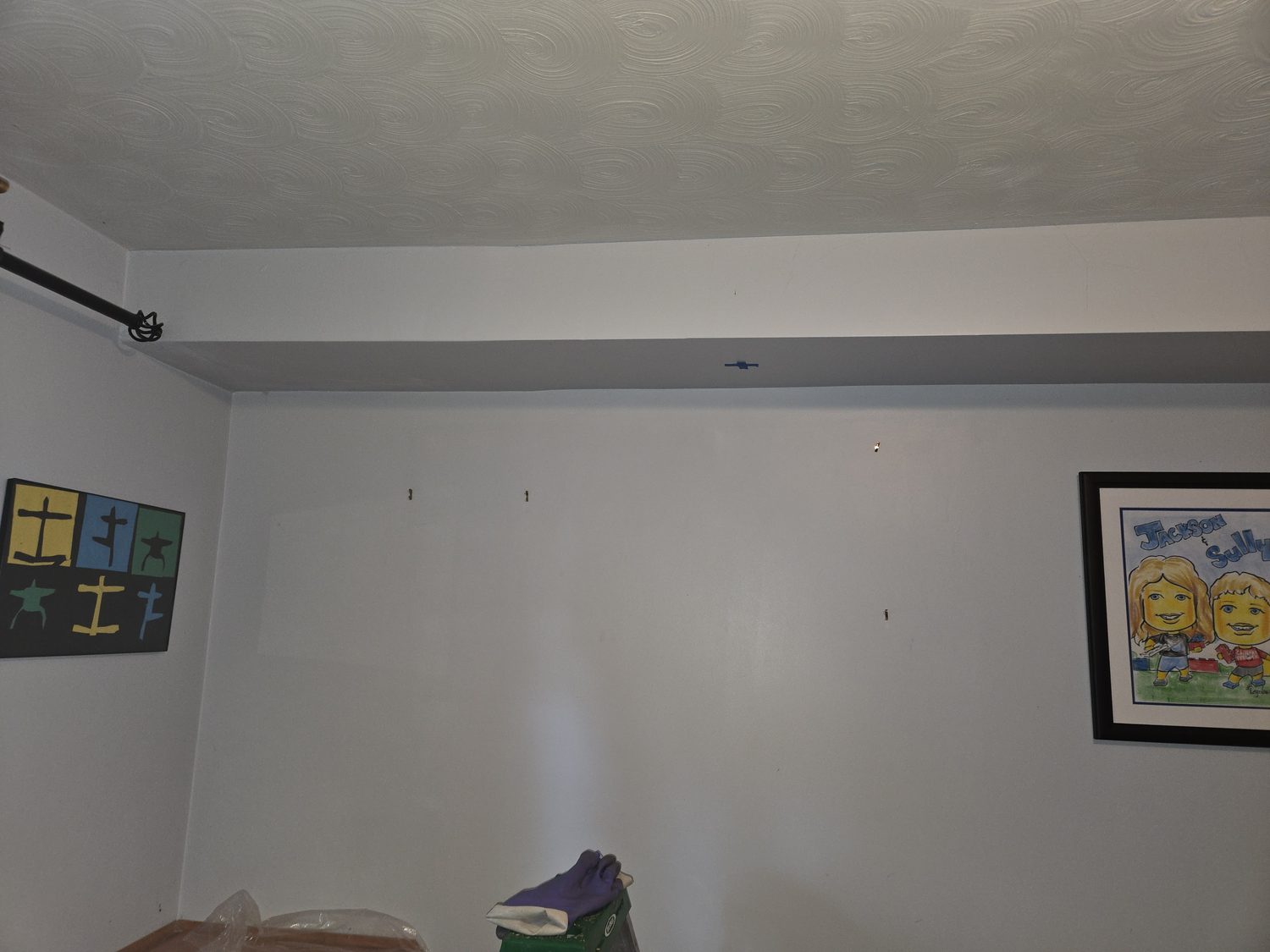
Step 2 — What the homeowner saw. Pristine bedroom wall, no stains, no entry point indoors. The bees were entering through a small gap in the exterior siding around the corner.
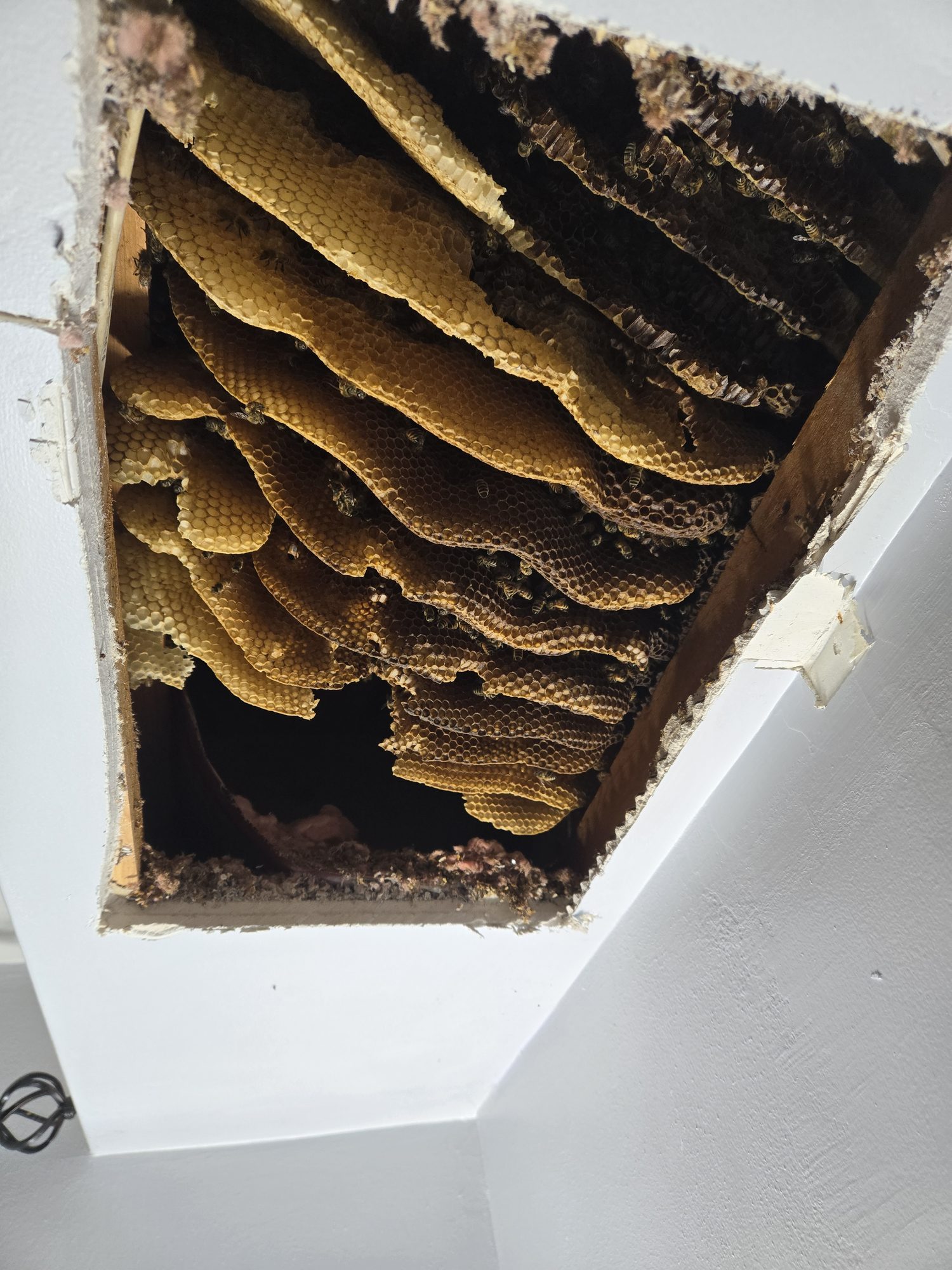
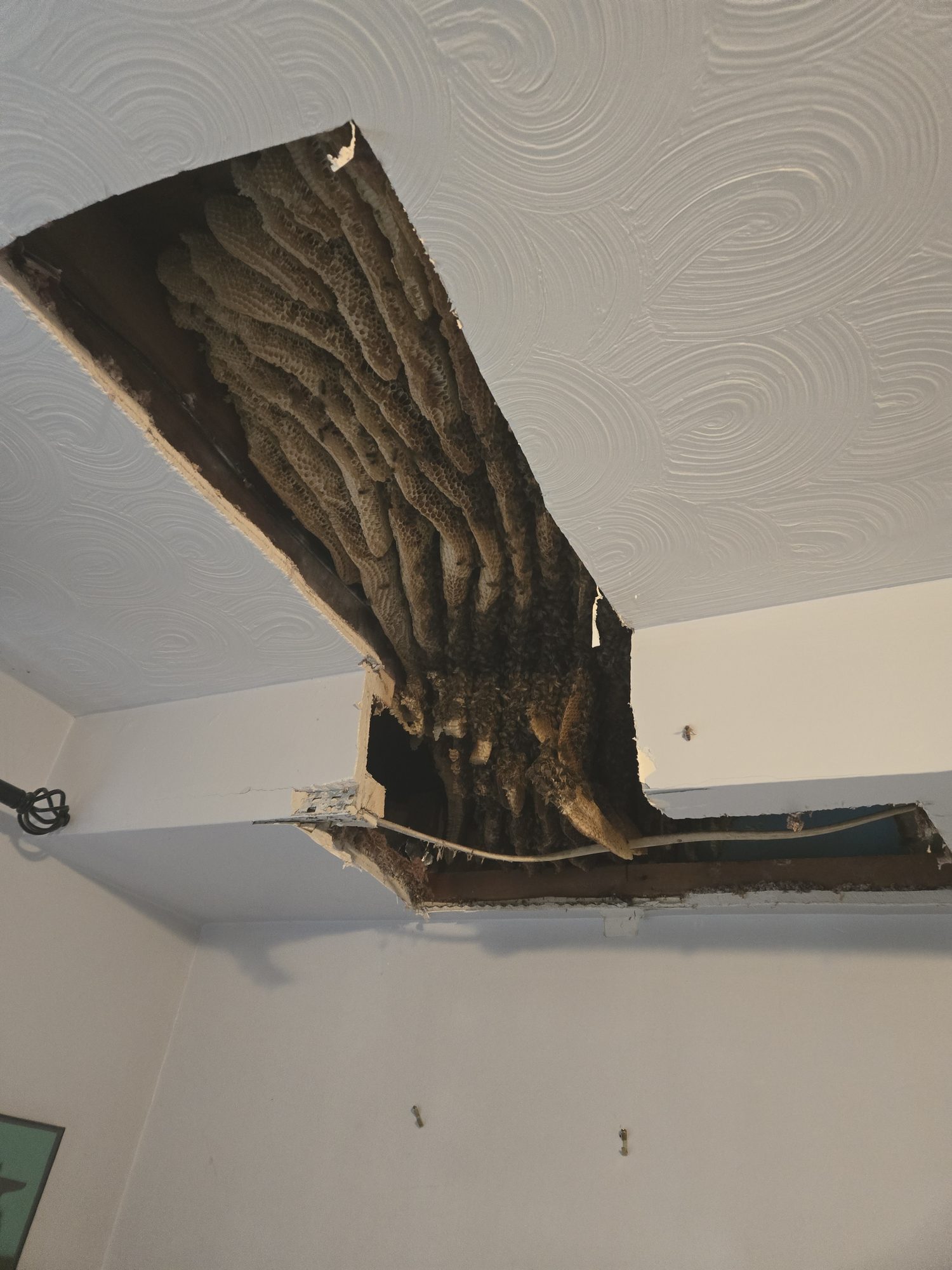
Step 3 — Drywall opened. Dense parallel comb sheets running along the stud bays, full of brood and capped honey. The thermal had it pinpointed.

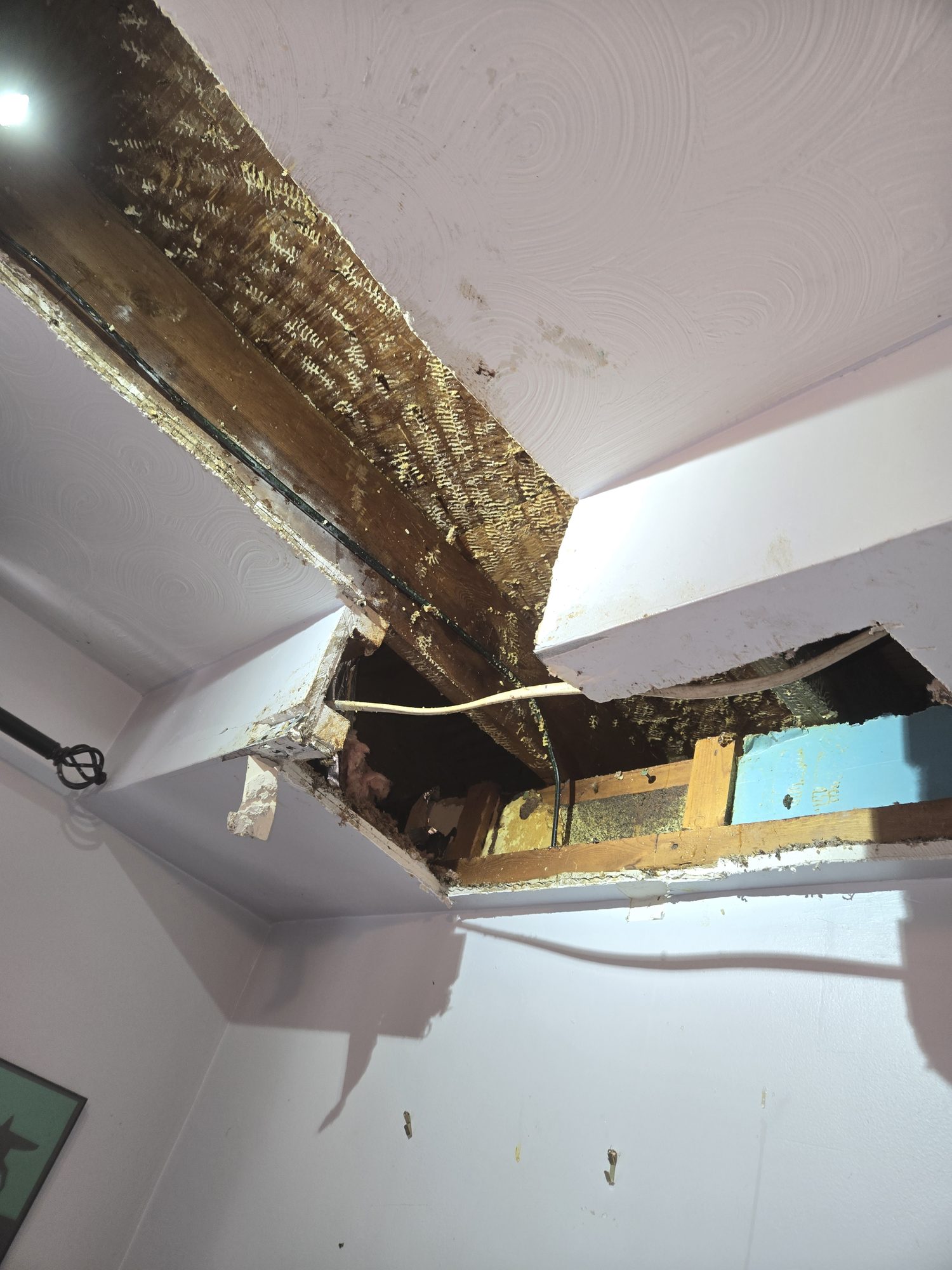
Step 4 — Full extent revealed. The colony wasn’t just in the wall — it ran around the corner into the ceiling, forming an L-shape across two cavities. About 35 pounds of comb total, by our estimate that day.

Step 5 — Cavity cleaned and ready. Bees vacuumed and en route to one of our apiaries, comb saved into transport frames, wall sealed temporarily until the homeowner’s contractor finished the patch. The colony was in their new hive within 24 hours.
This was a moderate-tier job that ran about 5 hours of on-site work. The homeowner had a handyman patch the drywall over the next weekend. No follow-up bee issues since.
How long does a wall removal take?
Most jobs are 3–6 hours of work, plus drive time. Larger or harder-to-reach colonies can take a full day. We’ll give you a time estimate during the on-site assessment.
How much does it cost?
Pricing depends on access:
- Standard ($650): one-story soffits, low porch eaves, anything reachable from a stool or stepladder.
- Moderate ($750–$1,000): second-story walls, taller chimneys, deeper Hershey/Harrisburg row-home walls — anything requiring ladders or scaffolding.
- Complex ($1,200+): bucket-lift work — tall Victorian chimneys, complicated multi-story access.
Free on-site estimate before any paid work begins. No deposit, no pressure. See our full pricing page for details.
What about my wall?
Once we’re done, the cavity will be sealed exterior-side and covered with plastic sheeting interior-side. The opened drywall or siding section needs a separate repair — usually a few hundred dollars from a handyman. We can occasionally recommend someone we’ve worked with if you don’t have one.
Why live removal, not extermination
Beyond the practical reasons we covered earlier (rotting bees, leaking honey, attracting pests), there’s a bigger picture: honeybees are pollinators essential to PA agriculture. Removing them alive lets a colony continue contributing to the food system instead of being destroyed.
Live removal is also the cleaner technical solution. Pest control companies that spray bees are taking the easy money and leaving you with the worst version of the problem — that’s why most reputable pest companies in the area decline honeybee work and refer customers to a beekeeper.
Why call a real beekeeper, not a “bee removal” website
A growing number of “Harrisburg Bee Removal” sites in the area are lead-generation services — they capture your call, sell your information to subcontracted providers, and skim a fee on the work. They have no real address, no owner name listed, advertise wasp control alongside live bee removal (a contradiction), and were registered last month.
We’re the opposite: a real owner-operated beekeeping business at 670 Swatara Street, Hummelstown PA 17036, ten years in Central PA beekeeping, with a self-serve honey stand and apiaries you can drive past. The person who picks up the phone is the person who’ll be on your roof. Your information stays with us — we never sell or resell it. See our licenses and insurance on our home page.
Ready to get the bees out?
Call or text (717) 583-8332 with a photo and the location of the colony. We’ll schedule a free on-site estimate and walk you through the process before any paid work begins.
We cover all of Hummelstown, Hershey, Harrisburg, Mechanicsburg, Camp Hill, Palmyra, Middletown, Elizabethtown, Linglestown, Colonial Park, and Lancaster.